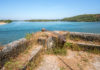
The Incredible Story of Tughlaqabad Fort, Delhi
This is the story of a dreamer who asked his master to make his dream come true. When the master refused, he did it himself! Ghiyas-ud-din Tughlaq had advised Mubarak Khilji to build a fortified city on a spot difficult to attack because of its elevated location and a stream and a nullah (open-drain) flowing along its north and south. As the fortified settlement would have been an expensive affair, Emperor Khilji told Tughlaq to do so when he became a king.

Tughlaq became a Sultan in the early 14th-century. And he created a fortified town at that spot called Tughlaqabad Fort.
During those times, River Yamuna flowed close by. Tughlaq commissioned the fort after assessing the flow and direction of the river and the nearby stream and checking the rise of water levels during monsoons.

Tughlaqabad Fort – The Cursed Fortress
Tughlaq took over the Delhi Empire in 1320 CE. Legend has it he was in a hurry to ready the fort soon. As a result, he contracted all the labour under a royal firman (decree) for the fort’s construction. Around the same time, Sufi Saint Hazrat Nizamuddin was trying to build a baoli (a step well) for his designated Sufi gathering place. Realising all the labour was commissioned by Tughlaq for building the fort, the only choice he had was to get the workforce to do his job in the night.
This helplessness infuriated Nizamuddin, and he pronounced a curse – Ya Rahe Gujjar, Ya Rahe Ujaad (either a shepherd tribe will live here, or it will be uninhabited). So, though the Tughlaqs occupied the fort for a brief while, they abandoned it soon after. Today, a strong Gujjar community thrives here, giving credence to the saint’s curse!

The Layout
The fort is on a high ground that marks the start of the Aravalli Mountain Range.
Its southern side has high walls. Logical, since the palace was in the south. To the north is an irregular trapezoid area or the city. It is the least well-defended. In fact, a high fortification wall and a defensive ditch defended the royal quarters from the city itself. The palace area is spread more from west to east and is shorter from south to north.

Of its four gates, one each in north, west, south, and east, the ones in the north and east opened into the city, while the other two opened out of the fort. The south gate opened out to the lake. While they considered the lake a deterrent for the enemy, still two bastions flanked the gate and the entry was not straight. Instead, it turned left at right angles, making enemy entry difficult. As a pre-gunpowder era fort, it had double walls at key places for the cavalry to move and guard against the enemy.

The architecture
A baoli (step well) and food silos served the palace area well. You can spot the ruins of a colonnaded audience hall. And to the east of the palace lies the citadel, the most defended part of the fort.
Amongst the other remains, a mosque, the houses (of lords and commons), a storage tank for construction material, an underground market, and a large mound to the east are remarkable.

The market street is well-maintained even today. Punctuated with openings at regular intervals, it allowed for easy access and light. The arches within suggest use of artificial lighting, too.

Just outside the market is Burj Mandal – the highest point of the fort. This spot accorded a comprehensive view to the entire city from one point. Despite the elements, this spot still rises almost 70 feet above the road beneath and provides a panoramic view of this massive fort.
The walls, gateways, remains of palaces, audience halls, and courtyards sprawl over an area of over 120 acres. Just goes to show the power and opulence of the Tughlaq dynasty.

Tughlaq Architecture
A significant feature of not just this fort, but all of Tughlaq period architecture is a wall with a massive base. The base in Tughlaqabad Fort is over 15 feet thick at places, while the top was almost dainty. Even the plain-jane look was a hallmark of all Tughlaq dynasty architecture. They were after functionality and speed. So, they used grey quartzite, accessible around Delhi, difficult to carve, and hence, often devoid of ornamentation.
Tughlaqabad is an architectural progression. Despite its advanced state of ruin, the imposing fortification, its palace, residences, and other structures reflect the ethos of the glorious era it once was!
📷 PHOTOGRAPHER’S FIELD NOTES — TUGHLAQABAD FORT
Best time to visit: November to March. Delhi winters bring clear skies and manageable light. Avoid May to June (extreme heat) and July to September (monsoon makes the uneven terrain treacherous). February and early March are the sweet spot — golden light and thin crowds.
Best light: The sloping grey quartzite walls face broadly south and west. Arrive at opening time (7 AM) — morning light picks out the rough wall texture beautifully before the sun climbs. The west-facing bastions and Burj Mandal catch warm amber light in the hour before sunset.
What to photograph: Burj Mandal — the highest point of the fort at 70 feet — gives a full panoramic sweep of the 120-acre complex. This is the establishing shot. The massively thick base walls tapering upward reward a wide composition with a person for scale. The arched market street with its regular overhead openings makes a natural leading-line shot. Across Mehrauli-Badarpur Road, Ghiyasuddin’s tomb — red sandstone, white dome, causeway — is a strong standalone frame that most visitors skip entirely.
What most visitors miss: The two baolis (stepwells) inside the fort — the East Baoli requires a deliberate detour and 30-step descent but delivers one of the most atmospheric looking-up compositions in Delhi. Also worth the 10-minute drive: Adilabad Fort, built by Muhammad bin Tughlaq just 2.3 km away, mirrors Tughlaqabad’s style and is almost always deserted.
What to bring: The TS-E 17mm is the standout lens here — the sloping, battered walls and arched gateways are exactly what perspective control is built for. The 17-40mm for wide rampart and cityscape shots from Burj Mandal. The 70-200mm for compressing the causeway and tomb across the road. The Leica V-Lux handles distant bastion detail from the high points — its 400mm reach picks out wall texture the Canon kit cannot match hand-held at range. Wear sturdy footwear — terrain is rough throughout. No photography fee.
Getting there: Nearest metro is Tughlakabad station on the Violet Line — auto-rickshaw from there takes about 10 minutes. By road: Mehrauli-Badarpur Road toward Tughlaqabad Institutional Area. About 20 km from IGI Airport. Entry: Rs. 5 for Indians, Rs. 100 for foreigners. Open 7 AM to 5 PM daily.
Combine with: Ghiyasuddin’s Tomb is directly across the road — factor in 20 minutes. Adilabad Fort is 2.3 km away and almost always empty. Qutub Minar is 10 km north — together these three make a strong full-day Delhi heritage circuit.
Pin the elegance!